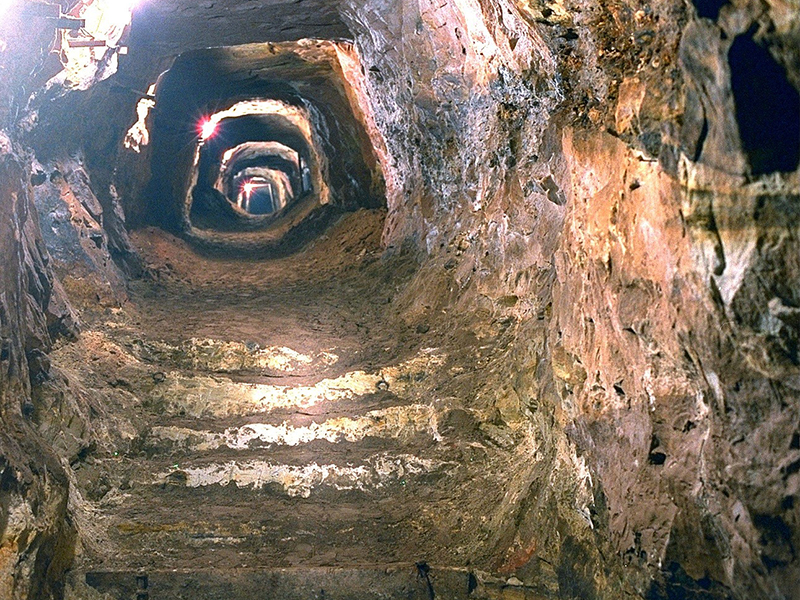
The Romans were already mining lead ore here. This has been confirmed by finds of Roman coins, mining troughs and lamps, as well as written records. Celtic coin finds point to prehistoric mining. The oldest document relating to metal ore mining dates from 1394. At that time, anyone was allowed to mine ore, but had to pay taxes to the local rulers.
The invention of the " bag basket" in the mid-15th century brought about an upswing, as it was used to sift the material on site and then transport it to the surface. From 1470 to 1530, mining expanded across the entire Bleiberg. The first mining regulations in 1578 put an end to unregulated mining. The self-employed miners were now given small fields. Towards the end of the 16th century, however, production stagnated because groundwater hindered the mining of deeper seams. From 1630 onwards, the water could be drained.
After the French takeover, concession distribution and mining rights were reorganised in 1805, and lead prices rose. Between 1860 and 1910, the lead mine eventually developed into one of the world's leading mining companies.
Preussag took over production in 1937. During the Second World War, up to 5,000 people sought shelter in the mine workings at times, and there was even a hospital with an operating theatre in the air-raid shelter. Mining ceased in 1957 due to a sharp drop in lead prices and difficult access to the ore. The mining museum, which opened in 1995, is run by a support association.