-
Langendorf Castle and
Clovis Stele -
-
Langendorf Castle
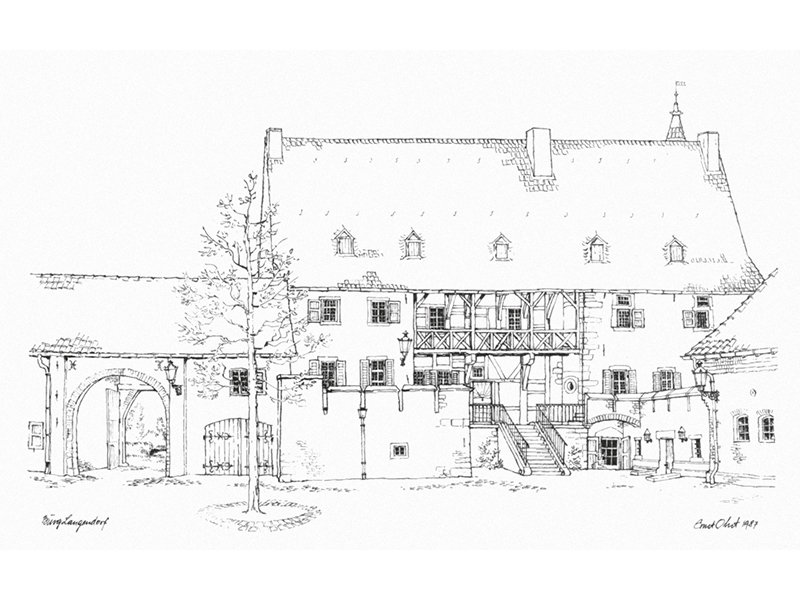
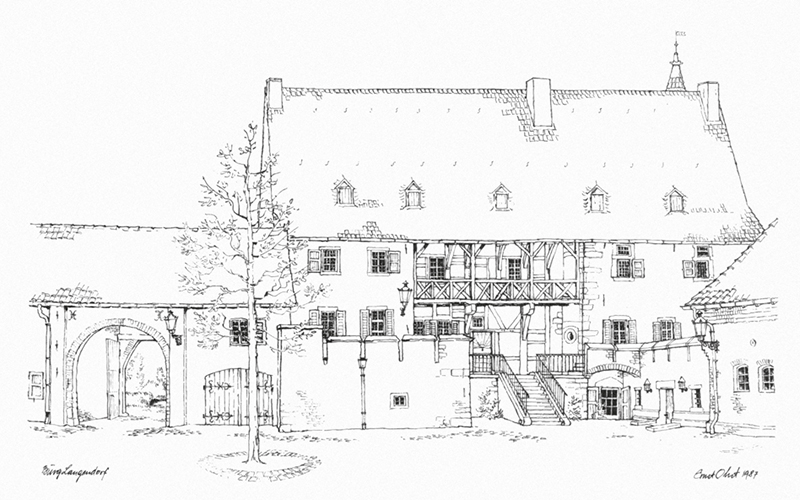
The late Gothic moated castle of Langendorf is considered one of the most magnificent manor houses between the Eifel and flood plains (Börde) regions. The site is mentioned in documents dating back to the 13th century. In the 15th century, the castle was expanded and took on its current form: a plastered castle house built of quarry stone with a courtroom in the basement was added. The outer bailey was also redesigned.
The late Gothic manor house was originally completely surrounded by moats. As the oldest part of the building, the round corner tower with a conical roof already belonged to a previous structure. The two-storey manor house is built in half-timbered style above a quarry stone cellar. On the first floor, a chapel bay window protrudes from sandstone blocks. Towards the tower, toilet bays for both floors are attached to consoles in a staggered arrangement. Mostly modern farm buildings on the outer bailey enclose an inner courtyard. The west wing dates back to the 16th century.
Ancestors of the current owner acquired the castle in 1880. The current owner succeeded in renovating the badly damaged castle over decades of work. Since then, it has served as a residence, and concerts are also held in the outer bailey.
Clovis Stele
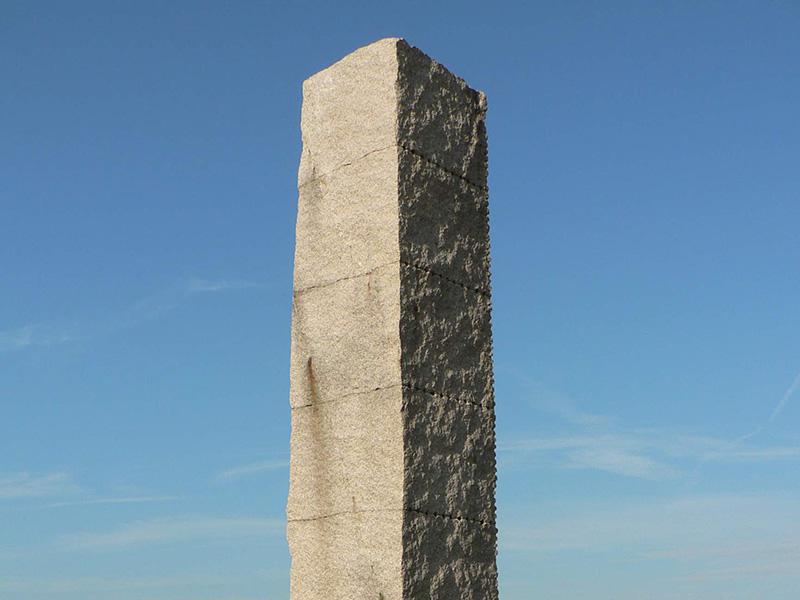
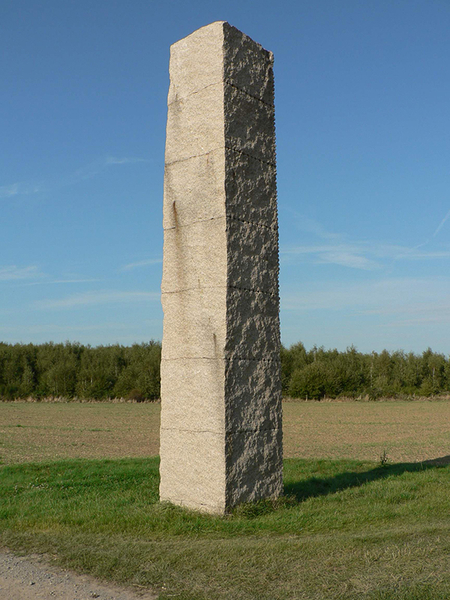
The eight-metre-high Clovis stele by the famous stone sculptor Ulrich Rückriem on the Wollersheim Heath commemorates the myth of the Battle of Clovis: According to medieval written sources, the Salian Frankish King Clovis, who came from what is now Belgium, rushed to the aid of his Rhine Frankish neighbour Sigibert in 496 when he was fighting the Alemanni.
During the battle, Clovis professed his Roman Catholic faith – which brought him victory and ultimately the entire Rhineland. Clovis later created a Frankish empire with Paris as its capital.
Although neither the year 496 nor Zülpich can be proven beyond doubt as the site of the battle, medieval chronicles consistently date the beginning of Clovis's aura as an invincible military commander to his victory in a battle at Tolbiacum (Zülpich). The fact that one of possibly several battles may have taken place here is also plausible because the Roman road network between Cologne and Maastricht was very well developed at that time.